
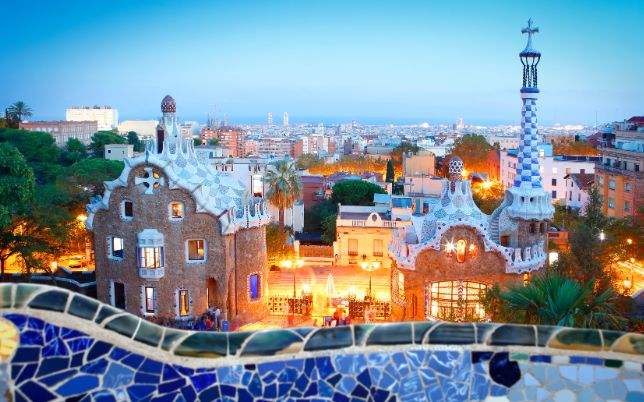
Park Güell raises more questions than almost any other attraction in Barcelona: Is admission free or do you have to pay? How much time should you set aside for it? Is it worth visiting if you’ve already seen the Sagrada Família? Let’s take it one step at a time.
One park, two very different areas
Antoni Gaudí designed Park Güell in 1900 at the request of businessman Eusebi Güell, with the idea of creating a luxury residential development surrounded by nature. The project was a commercial failure—only two of the planned lots were sold—and in 1926 the land became a municipal public park. This history explains why the park is now divided into two areas with different rules: a large public area that is free to enter, and a «Monumental Zone» that requires an admission fee and contains the most frequently photographed features.
What's in the Monumental Zone (the one you have to pay to enter)
Here’s everything you recognize from the postcards: the grand staircase with the mosaic salamander, the Hypostyle Hall with its slanted Doric columns, and the large, undulating terrace covered with trencadís (a mosaic made of broken tiles, a technique popularized by Gaudí). Access is limited to specific time slots with controlled capacity, so you’ll need a ticket with an assigned time slot.
What's in the free section?
The rest of the park—trails, viewpoints, the Gaudí House-Museum (which does require a separate admission ticket), and several landscaped areas—is free to the public, with no time restrictions or reservations required. In fact, some of the best panoramic views of Barcelona are in this free area, without having to pay for admission to the Monumental Zone.
When to go to avoid crowds
The time slot from 8:00 to 9:30 a.m. is by far the quietest—you’ll arrive before the organized groups, and the early morning light is great for photos. The other good option is the last time slot of the afternoon, one hour before closing. Noon, especially from May through September, is when it’s most crowded.
The tailless mosaic salamander
It’s the most photographed spot in the park, and depending on the time of day, there can be lines of 15–20 minutes just to take a picture. Here’s the trick: it’s located on the staircase leading into the Monumental Zone, so if you arrive right when it opens, you’ll have it practically all to yourself. If you go mid-morning, be patient or look for angles from the sides of the staircase, where you can also get a good view without waiting in line.
How much time to devote to it
For the Monumental Zone alone: 60–90 minutes are enough. If you want to combine it with a stroll through the rest of the park and its overlooks, plan on spending half a day, especially if you walk up from downtown (the elevation gain is considerable). Most visitors who only go to the Monumental Zone and rush off end up missing the very part of the park that few people see.
How to Get There
The park is located in the upper part of Barcelona, in the La Salut neighborhood. There isn't a metro station right at the entrance—the most convenient options are the tourist bus, a taxi or ride-hailing service, or the city bus to the nearest stop, followed by a short walk up the final stretch. If you’re walking from Gràcia, expect a 20- to 25-minute uphill walk.
Is it worth it if you're already going to see the Sagrada Família?
Yes, and for one specific reason: they are different experiences. The Sagrada Família is interior architecture—vertical and almost religious in its effect. Park Güell is exterior and horizontal, and it shows Gaudí playing with the landscape and color rather than with stone. If you only have time for one more thing beyond the essentials, this is the most common recommendation among those who have already visited both.
At VenturPass, we're working on a direct ticket booking service for Park Güell and other landmarks in Barcelona—check back soon, or follow us for updates.